Ellsworth
Butcher's CrossingEllsworth is the supply point from which Miller equips the hunting expedition that leaves Butcher’s Crossing for the mountains. Its significance is practical and structural: the town provides a wagon, oxen, and cheaper provisions, turning Miller’s plan into a material undertaking. The novel also places Ellsworth within a wider, changing economy, where the depletion of Kansas bison and the arrival of railroad buyers alter the value of what hunters take from the land.
Setting and Routes
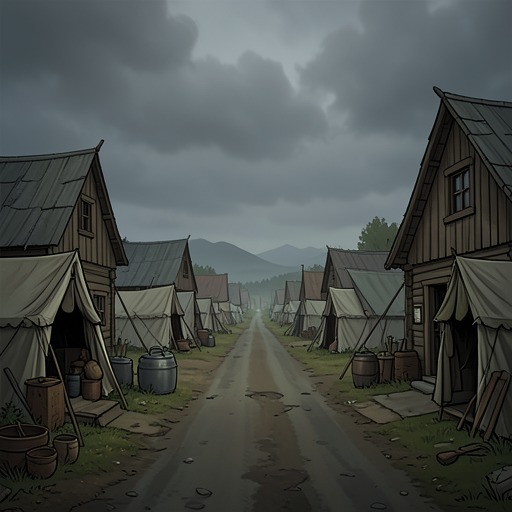
The first view of Butcher’s Crossing comes from the road descending from Ellsworth. A freight wagon has been adapted to carry passengers and small luggage; four mules pull it over a rough, rutted track that slopes gently down from the plains. Its shifting cargo, flapping curtains, and jolting small wheels make the journey tangible before the settlement appears. The driver’s announcement that the party has arrived marks Ellsworth as the point of departure for the novel’s central journey into the frontier.
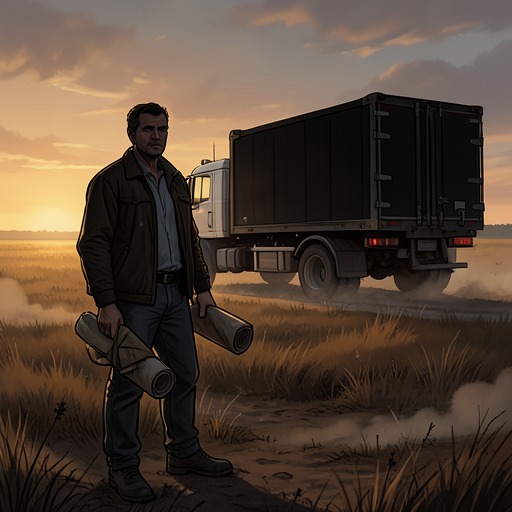
Ellsworth recurs not as a fully described town but as a place connected to Butcher’s Crossing by travel and trade. Miller says he will go there to obtain equipment for the expedition. The narrative later measures his absence against the expected schedule: after setting out, he returns to Butcher’s Crossing six days later, bringing a long string of oxen and the wagon. The return is staged through dust, shouting, the crack of a whip, and the slow approach of the animals, making a procurement trip into a visible arrival that changes the expedition’s prospects.
Supplies for the Expedition
Miller chooses Ellsworth because he knows someone there with a good wagon and expects oxen to be available. He also plans to buy provisions there because they cost less. These arrangements give the expedition a concrete basis: the journey will depend not only on Miller’s knowledge of hunting but on a vehicle, a team capable of hauling it, and supplies acquired before the party enters the mountains.
When Andrews asks how the trip to Ellsworth went, Miller reports that he bought the wagon at a good price. Some of the oxen are untamed, and a pair need shoeing, although the lead animals are sound and he expects to break in the others within a few days. The details qualify the idea of preparation: Miller has secured what the expedition needs, but the animals and equipment still require work before they can be relied on. His return comes six days after his departure, a little longer than the four or five days he had anticipated.
Ellsworth in the Changing Bison Economy
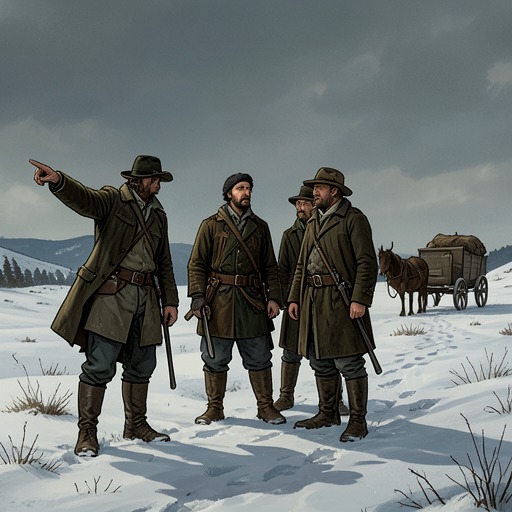
Miller’s account of the Kansas hunt supplies a longer historical frame for Ellsworth’s role. He recalls arriving in the region four years earlier, the same year as McDonald, when the plains in spring appeared black with bison for miles. Two weeks of hunting could then yield a thousand or fifteen hundred animals, including valuable spring hides. By the time he speaks, hunters are fortunate to take two or three hundred in a season, and Miller expects that Kansas will have no bison left to hunt within another year or two. Ellsworth belongs to a landscape whose apparent abundance has already been sharply reduced by commercial hunting.
That depletion also changes the meaning of the expedition’s supplies. Miller’s purchase of transport and provisions supports a venture that seeks a remaining herd beyond the depleted Kansas hunting grounds. Later, Andrews recognizes that Miller will not leave the valley while any bison remain alive; the carcasses accumulating across the valley turn the expedition’s pursuit into an intended extermination. The wagon and oxen obtained at Ellsworth are therefore not neutral equipment: they enable a hunt whose scale and consequences exceed the ordinary business of bringing hides to market.
Trade and Narrative Significance
The later news about the railroad clarifies how quickly the region’s commercial priorities are shifting. McDonald says the tracks are being laid fifty miles north of Butcher’s Crossing. Hunters are selling bison meat to the railroad company while leaving the hides to rot where the animals were skinned. His remark points to a changing market: meat that Miller’s party leaves to flies and wolves could have earned nearly five cents a pound. This information does not establish a railroad connection to Ellsworth itself, but it places the town’s supply function within a wider network of settlement and extraction.
Ellsworth’s narrative importance lies in this combination of ordinary logistics and larger change. The coach’s rough descent introduces the route into Butcher’s Crossing; Miller’s return with a wagon and oxen makes the expedition possible; and the account of dwindling herds shows what such ventures are entering and helping to destroy. Ellsworth is not presented as a destination in its own right so much as a point of passage where the resources for frontier enterprise are assembled, while the consequences of that enterprise extend far beyond the town.